Same chicken plant, two contractors: one service, one labour hire
Application by the Australasian Meat Industry Employees’ Union re cleaning work at Bartter Enterprises’ poultry processing facility [2026] FWC 795
- Decided by
- Fair Work Commission
- Date
- 17 March 2026
- Outcome
- Cleaners' claim dismissed; deboners' pay order upheld
- Result
- Mixed result
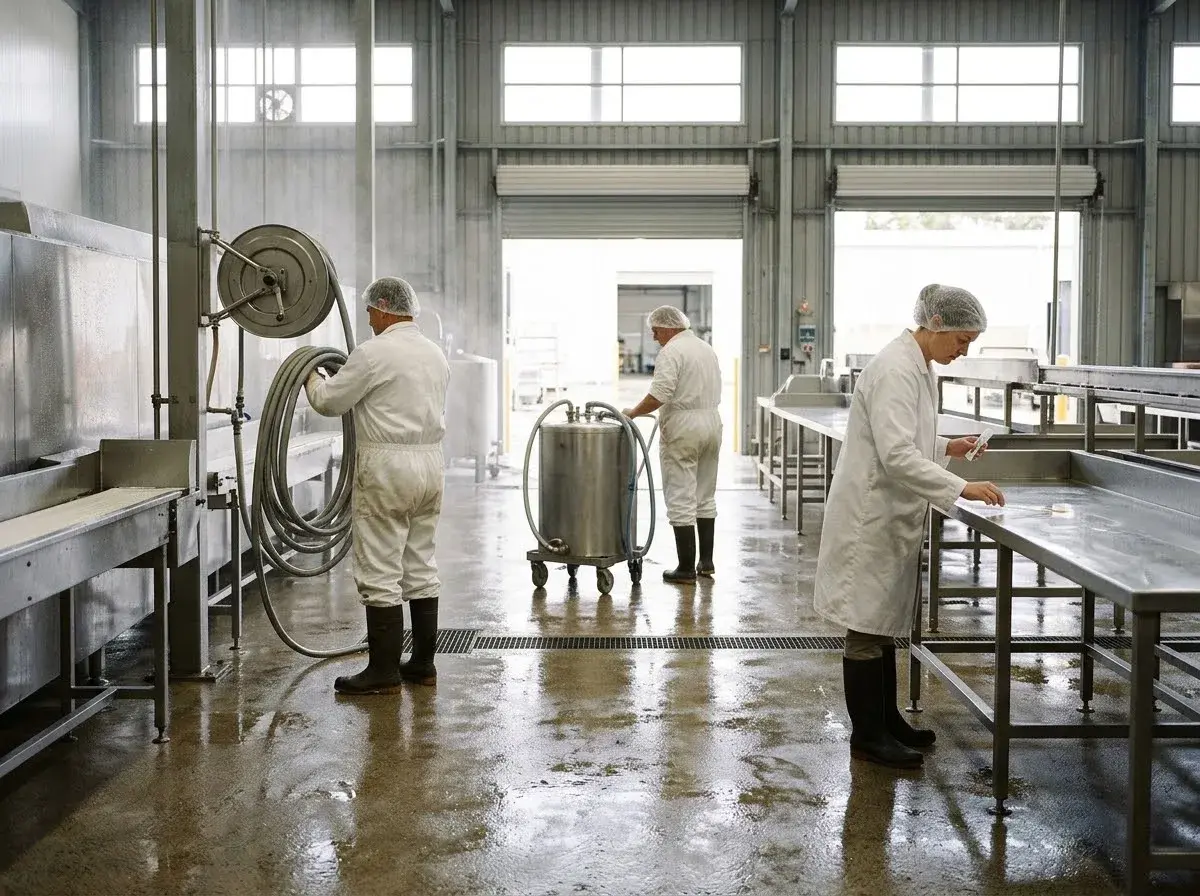
The meat workers' union asked the Fair Work Commission for 'same job same pay' orders covering two groups of contractors' workers at a poultry processing plant near Newcastle: the industrial cleaners and the chicken deboners. On the same day the Commission refused the cleaners' order, because their employer was providing a service, and made the deboners' order, because their employer was in substance supplying labour. A Full Bench later upheld the deboners' order.
Key points
- Under the Closing Loopholes laws, the Commission must, on application, order that labour hire workers be paid at least the host's enterprise agreement rates if the conditions are met, unless an exception applies.
- The order cannot be made if the contractor is providing a service rather than supplying labour, judged by who controls the work, whose equipment and systems are used, industry standards and how specialised the work is.
- The cleaning contractor ran the work end to end with its own supervisors, equipment, chemicals and food safety systems, so it was providing a service.
- The deboning contractor's skilled workers used the host's benches and crates, worked alongside the host's staff, and the host paid the contractor by the weight of meat deboned, so it was supplying labour.
One plant, two contractors
Bartter Enterprises runs the Steggles poultry processing facility at Beresfield, near Newcastle. Its 700 or so employees there are covered by the Steggles Beresfield Site enterprise agreement. This case is about two jobs there that are contracted out.
Each day, after processing ends, about 20 workers employed by TCS, trading as Cleaning Edge Solutions, come in and sanitise the plant: food-contact surfaces, drains, deep floor cleans, weekend acid washes and fogging. Industrial cleaning had been contracted out since at least 2012.
On day and afternoon shifts, about 50 workers employed by J&T Trade debone chickens by hand, the specialty cuts that machines cannot do. Manual chicken deboning had been contracted out since about 2008 or 2009.
The claim: same job, same pay
On 7 August 2025 the Australasian Meat Industry Employees Union applied for a regulated labour hire arrangement order for each group. This is the Closing Loopholes 'same job same pay' order. If made, the contractor must pay its workers at least the protected rate of pay, meaning what they would get under the host's enterprise agreement if the host employed them directly (s 306F(2) of the Fair Work Act 2009 (Cth)).
Under s 306E(1), the Commission must make the order if a business supplies its employees to work for a host, the host's agreement would apply to them if the host employed them, and the host is not a small business. Two exceptions follow. Under s 306E(1A), the order cannot be made unless the Commission is satisfied the work is not for the provision of a service rather than the supply of labour. Under s 306E(2), it cannot be made if the Commission is satisfied that it would not be fair and reasonable.
To decide the service question, s 306E(7A) lists five matters: how involved the contractor is in the work; how far it directs, supervises and controls its workers, including rosters, tasks and quality checks; whether the workers use the contractor's own systems, plant or structures; industry or professional standards; and how specialised the work is.
Why the cleaners' claim failed
Bartter and TCS first argued that the agreement could not apply to cleaners. It covered Bartter only through a 2023 transfer of business from Steggles, which had never employed industrial cleaners. Deputy President Saunders rejected that. Viewed broadly, the work at the plant included cleaning it so work could continue the next day, and the cleaners would fall within a Level 3 classification.
The order still failed on the service exception. TCS is a specialist industrial cleaning business with 315 employees, operating in New South Wales, Victoria and Western Australia, and it holds food safety certification. It supplied every hose, foamer and chemical. Its own site manager and team leaders supervised, rostered and trained the cleaners, who wore TCS uniforms. Bartter paid a weekly charge, and the contract set no headcount or hours.
Bartter's quality assurance officer checked the result only after a TCS team leader had signed off. The Deputy President found that check was about Bartter's own food safety duties, not supervision of the cleaners. The cleaning was 'an identifiable service' beyond the mere supply of labour, so the application was dismissed.
Why the deboners' claim succeeded
The same day, in [2026] FWC 873, the Deputy President made the order for the deboners. J&T did train and supervise its own workers, and Bartter did not tell them how to cut. But Bartter decided each morning, by a daily direction sheet, how much and which cuts were needed, weighed what each deboner produced, and its managers walked the line checking quality and waste.
J&T's knives and mesh gloves were tools, not plant. The deboners worked at Bartter's benches, put meat into Bartter's crates, and Bartter's own staff brought the chickens and took the meat away. Bartter employees also deboned turkeys and trimmed chicken, similar work requiring less skill. The Deputy President found the arrangement was 'essentially for the supply of skilled labour' and that it was fair and reasonable to make the order, so the deboners must be paid no less than the agreement rate, the Level 4 rate paid to Bartter's own manual deboners.
The appeal
The order came into force on 31 March 2026. A week before that, J&T told Bartter it would stop providing its services from 19 April 2026. Bartter appealed.
On 11 September 2026 a Full Bench granted permission to appeal but dismissed it. The service question calls for judgment, it held, so the decision could be overturned only for an error such as acting on a wrong principle or mistaking the facts, not because another member might weigh the factors differently. No such error was shown, and the Full Bench also agreed the agreement would apply to the deboners.
What this means for you
If your business outsources work, the label on the contract will not decide this. What matters is the reality: who controls the work day to day, whose equipment and systems are used, and whether the work is a distinct service or part of your own production line done alongside your staff. Paying the contractor by output rather than by the hour did not stop the deboners' order.
If you use labour hire and have an enterprise agreement, it is worth reviewing each arrangement against the s 306E(7A) matters before a union applies, and budgeting for agreement rates where the work looks like supplied labour. An order also follows the work: when a new contractor takes over, the host must apply to vary the order to cover it.
The takeaway
A contractor that runs a job end to end with its own people, systems and equipment is likely to be providing a service. One whose workers slot into your production line is likely to be supplying labour, and may have to be paid your agreement rates.
Note: The order for the deboners ([2026] FWC 873) was upheld by a Full Bench in Bartter Enterprises Pty Limited v The Australasian Meat Industry Employees Union [2026] FWCFB 233 on 11 September 2026. No appeal from the cleaners' decision ([2026] FWC 795) was found in the decisions available to us, but that could not be confirmed. This decision may be under appeal.
Fair Work Commission · 17 March 2026
Application by the Australasian Meat Industry Employees’ Union re cleaning work at Bartter Enterprises’ poultry processing facility [2026] FWC 795, Deputy President Saunders. Read the full decision
This is a plain-English summary of the published decision, for general information. It is not legal advice, and every case turns on its own facts.
Does this sound like your situation?
More case studies

Full Court of the Federal Court of Australia · 17 March 2026
A university said marking was already paid. The Full Court disagreed
Fair Work Ombudsman v Torrens University Australia Limited
A university paid a casual design lecturer the award's lecture rate and, in most cases, nothing extra for marking her own students' work. A Fair Work Inspector issued a compliance notice. The university had it cancelled by a single judge, but the Full Federal Court reversed that decision and confirmed the notice: under the award, marking is generally paid at the separate marking rate.
Compliance notice confirmedPay & contracts#underpayment#for employers#casual work
Read the case study
Fair Work Commission · 2 April 2026
Cut off from a work portal: why the gig worker law did not apply
Jooste v Scribefire TMS Trading as Scribefire Pty Ltd
A transcriber who supplied transcripts through a transcription business's online portal was suspended and given notice that her supplier agreement was ending. She applied to the Fair Work Commission under the Closing Loopholes protection against unfair deactivation. The Commission found the portal was not a digital labour platform, so she was not an employee-like worker and the claim was dismissed without the merits being heard.
Application dismissedPay & contracts#contractors#for employers#contracts
Read the case study
Fair Work Commission · 24 February 2026
Refused the same job four minutes further away, lost redundancy pay
Application by Civmec Construction And Engineering Pty Ltd
When his projects at Civmec's Henderson workshop ended, an electrical projects engineer was offered the same role, on the same pay, at the CSBP site in Kwinana. He refused it and asked to be made redundant. The Fair Work Commission found the Kwinana role was other acceptable employment and reduced his six weeks' redundancy pay to nil.
Redundancy pay reduced from six weeks to nilPay & contracts#redundancy#for employers
Read the case study