Called a 'stupid coconut' at work, hotel worker awarded $120,000
Vunipola v Redmond Company Pty Ltd [2026] FedCFamC2G 2024
- Decided by
- Federal Circuit and Family Court of Australia (Division 2)
- Date
- 28 August 2026
- Outcome
- $120,000 general damages, plus $9,540 for treatment and costs
- Result
- Employee succeeded
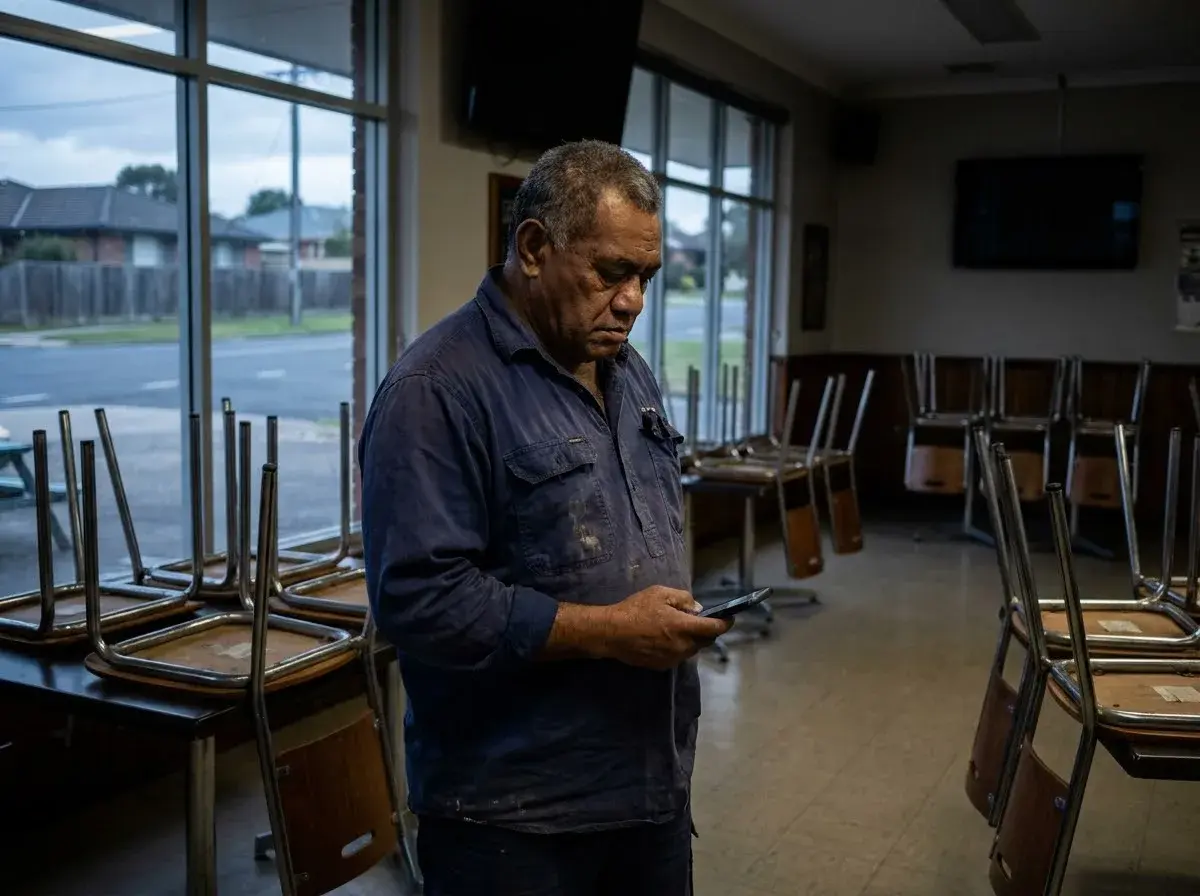
Toa Vunipola said that after a new licensee took over the Vegas Hotel, he was called a "stupid coconut" and a "stupid Tongan" and subjected to ageist and sexual comments. The company did not defend his claim, and the Federal Circuit and Family Court awarded him $120,000 in general damages, $9,540 for future psychological treatment and his legal costs on an indemnity basis.
Key points
- Racial, sexual and age-based abuse at work can breach three separate federal anti-discrimination laws at once.
- There is no cap on damages in a federal discrimination claim, and the court was taken to recent awards of $90,000 to $160,000 in general damages where serious harm was proved.
- The court looked at the abuse as a whole: different kinds of discrimination together can humiliate more than each incident alone.
- Ignoring a court claim does not make it go away: the company lost by default and was ordered to pay costs on the higher, indemnity basis.
What happened
Toa Vunipola worked at the Vegas Hotel. A clinical psychologist later reported that the culture at work "changed dramatically" once a new licensee was appointed, and that Mr Vunipola was then exposed to racist and ageist comments that "ridiculed and belittled him".
In his sworn evidence, Mr Vunipola said the licensee called him a "stupid coconut" and a "stupid Tongan". He said the comments left him distressed and embarrassed, and that they were aimed not only at him but at his nationality, his people and his family. His claim also described abusive comments of a sexual nature that he found highly offensive.
His wife said he often rang her at work in tears. She urged him to stay home, but he kept going in because he was worried he would lose his job if he did not.
The claim
Mr Vunipola brought a claim against Redmond Company Pty Ltd and the licensee personally under three federal laws: the Racial Discrimination Act 1975 (Cth), the Sex Discrimination Act 1984 (Cth) and the Age Discrimination Act 2004 (Cth). Claims under these laws start as a complaint to the Australian Human Rights Commission, and if that does not resolve them, they can go to court under the Australian Human Rights Commission Act 1986 (Cth).
The company did not defend the case. The court made declarations against it "by default", which means the claim was accepted without a trial because the other side did not answer it. No-one appeared for either respondent at the damages hearing on 28 August 2026. Judge Humphreys said they had "effectively conveyed to the Court, 'Do whatever you want.'"
The harm
The psychologist diagnosed major depressive disorder, assessed as severe and chronic, and found Mr Vunipola had been traumatised by his treatment at the hotel, with nightmares, hypervigilance and a heightened startle response. This was so although he had not worked there for over three years. The judge accepted the report.
Mr Vunipola said he had lost motivation, weight and sleep, withdrew from his family and friends, and did not believe he could ever work again. Out of work and struggling with the mortgage, he had to sell the family home. His wife, a disability support worker, said she had taken on supporting a family of 9 children and 16 grandchildren; they now rent and receive JobSeeker payments.
Why: the legal test for damages
Section 46PO(4)(d) of the Human Rights Commission Act lets the court order a respondent to pay "damages by way of compensation for any loss or damage suffered because of the conduct of the respondent". There is no monetary ceiling. General damages are the part of that compensation that pays for non-financial harm: hurt, humiliation, distress and psychiatric injury.
The judge set out the principles. The amount must be reasonable given the severity of the injury and suffering, suit the person's own circumstances, be proportional to the harm, be consistent with comparable cases, reflect community standards, and not double up on any other award.
On comparable cases, Mr Vunipola's lawyer relied on the leading case, Richardson v Oracle (2014), where the Full Court of the Federal Court replaced an award of $18,000 for workplace sexual harassment with $120,000. He also cited later decisions which, he said, show awards on that scale are now made regularly: $120,000 in Hughes v Hill (2020), $90,000 for age discrimination in Gutierrez v MUR Shipping (2023), $140,000 in Taylor v August and Pemberton (2023) and $160,000 in Magar v Khan (2025). Gutierrez also confirms that the discrimination need not be the only cause of an injury; it is enough that it contributed.
How the judge applied it
Judge Humphreys pointed to six matters. The conduct targeted fundamental parts of Mr Vunipola's identity, his race, sex and age, and happened at work, where people spend much of their waking lives. It had to be looked at as a whole, because "different forms of discrimination may give rise to distinct forms of humiliation that combined can be substantially greater than the sum of the individual incidents."
He also weighed the serious depression and the finding that Mr Vunipola is unlikely ever to work again, the harm that spread into his life outside work, his wife's evidence of what the family had suffered, and community standards: racism at work "ought to be eliminated entirely from the workplace".
Mr Vunipola sought at least $150,000. The judge thought that excessive, and awarded $120,000 in general damages, plus $9,540 for 30 sessions with a psychologist. The company was also ordered to pay his legal costs on an indemnity basis, which covers more of them than the usual order. He was given 28 days to file evidence of future lost earnings, so a further award may follow.
What this means for you
If you are called names at work because of your race, nationality, sex or age, it can be unlawful discrimination. Where the harm is serious and proved, the damages can run to six figures. Evidence matters: here a psychologist's report and sworn accounts from the worker and his wife proved the harm. Keep a record of what was said and when, and see your doctor if it affects your health.
For employers, the lesson is just as plain. A complaint about abuse should be dealt with, and a court claim never ignored. The federal discrimination laws apply in Western Australia, and WA workers may also have a claim under the Equal Opportunity Act 1984 (WA). Complaints have time limits, so it is worth getting advice early.
The takeaway
Racist and ageist abuse at work is unlawful discrimination, and where it causes serious harm the courts now award substantial damages, in this case $120,000 for hurt and humiliation alone.
Note: This was a default judgment: the company did not defend the claim, so the allegations were not tested at a trial. The court gave Mr Vunipola 28 days to file evidence of future economic loss and said it would then consider a further award; no later decision was found.
Federal Circuit and Family Court of Australia (Division 2) · 28 August 2026
Vunipola v Redmond Company Pty Ltd [2026] FedCFamC2G 2024, Judge Humphreys. Read the full decision
This is a plain-English summary of the published decision, for general information. It is not legal advice, and every case turns on its own facts.
Does this sound like your situation?
More case studies

ACT Civil and Administrative Tribunal (Appeal Tribunal) · 18 March 2022
Union delegate spoke to the press, then faced possible counselling
Casino Canberra Limited v Kidman (Appeal)
Mr Kidman, a casino inspector and union delegate, told The Canberra Times that staff were in the dark about a pending sale of the casino. Two days later the casino's in-house lawyer wrote to him suggesting he may have breached the employee handbook and foreshadowing formal performance counselling. The ACT Civil and Administrative Tribunal found this was unlawful discrimination because of his industrial activity, and on appeal the $4,000 damages and $4,620 costs order stood.
$4,000 damages and $4,620 costs upheldDiscrimination & bullying#discrimination#general protections#investigations
Read the case study
Guide · first published September 2016
Treated differently at work because of your age? What the law says
It is unlawful for an employer to treat a worker or job applicant worse because of their age, whether they are 19 or 65. This guide explains the federal laws that apply, who has to prove what, the exceptions, and two court cases in which employers were held responsible.
GuideDiscrimination & bullying#age#discrimination#general protections
Read the guide
Australian Human Rights Commission · March 2016
Sacked in his second week over a drug conviction: it was discrimination
AW v Data#3 Limited
A technology company dismissed a senior IT specialist in his second week after it learned of his New Zealand drug conviction. The Australian Human Rights Commission found the dismissal was discrimination on the basis of criminal record and recommended he be paid $76,639. The company agreed to change its policies but declined to pay.
Discrimination found; $76,639 recommended, not paidDiscrimination & bullying#discrimination#compensation#for employers
Read the case study