Told to show cause, he asked to see the investigation report
Aurizon Operations Limited v Cameron Webb [2024] FWCFB 318
- Decided by
- Fair Work Commission (Full Bench)
- Date
- 25 July 2024
- Outcome
- No right to the report, but the investigation was found unfair
- Result
- Mixed result
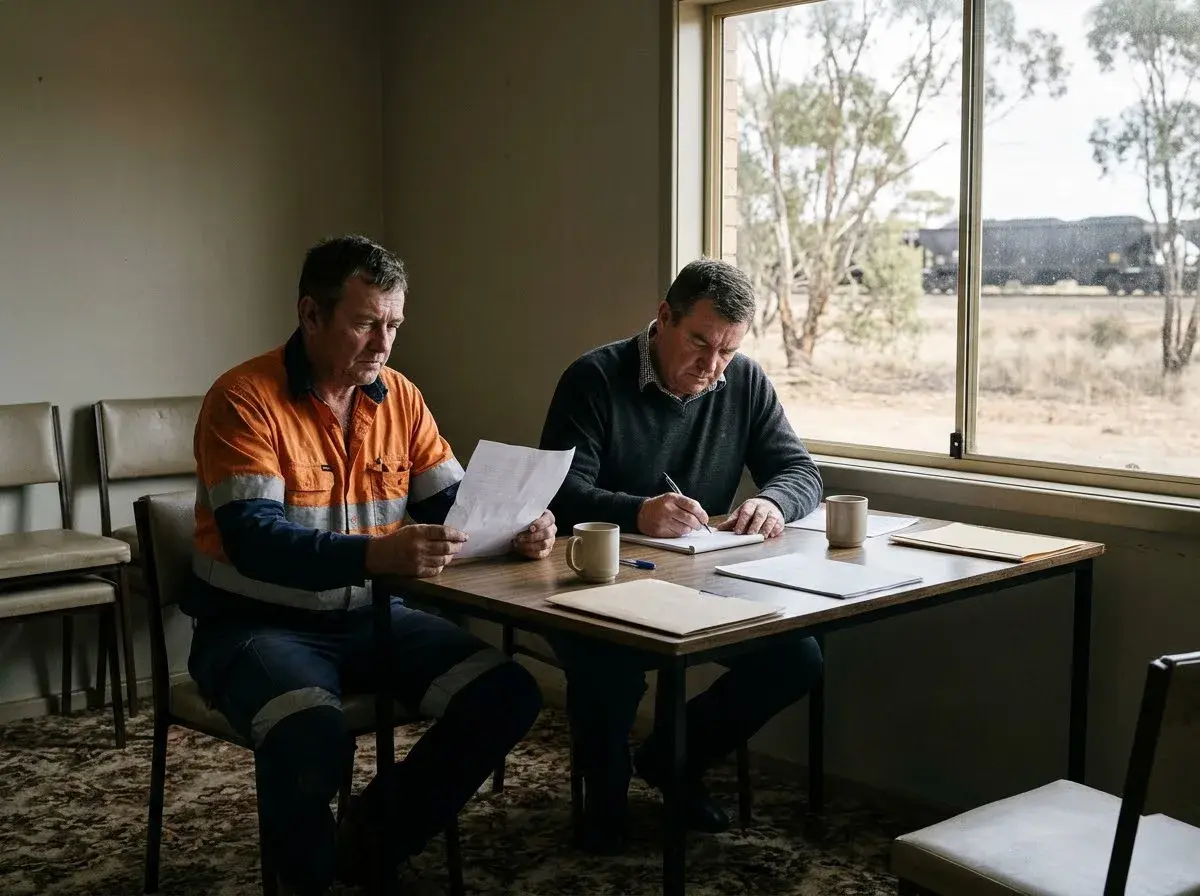
An external investigator found allegations against a coal rail worker proven, and Aurizon asked him to show cause why he should not be sacked. His union asked the Fair Work Commission to make Aurizon hand over the investigation report. The Full Bench said his enterprise agreement gave him no right to the report itself, but agreed he had been denied natural justice because the evidence against him was never put to him.
Key points
- Under the enterprise agreement in this case, a worker facing a show cause letter had no right to a copy of the investigation report.
- Where natural justice applies, the employee must be told the substance of credible, relevant and significant adverse evidence from other people and given a chance to answer it.
- That should happen during the investigation, before the investigator makes findings, not afterwards.
- The Full Bench said it would be prudent for the employer to re-open the investigation so the worker could respond.
What happened
Cameron Webb worked for Aurizon, the rail freight operator, under the Aurizon NSW Coal Operations Enterprise Agreement 2021. He was a member of the Australian Rail Tram and Bus Industry Union (RTBU).
On 8 January 2024 Aurizon gave him a letter of allegations about his conduct on 9 and 15 December 2023, and directed him to attend an interview with an external investigator the next morning. The decision does not describe the allegations in detail. His union spent that afternoon emailing an Aurizon regional operations manager, asking whether he had been given all the material Aurizon relied on.
Mr Webb attended the interview on 9 January 2024. Aurizon said he also gave a written response denying the allegations. The investigator found the allegations proven. On 23 January 2024 the manager read him a show cause letter, which asked him to explain in writing why his employment should not be terminated. A show cause letter is an employer's formal invitation to respond before it decides on discipline, often dismissal.
The request for the report
At that meeting the union asked for a copy of the investigation report, and offered to accept it with witnesses' names blacked out. Aurizon refused, saying the report was confidential.
In a later email the manager explained how the investigator reached his view. Noting that concerns are often raised where there is no witness, he said the investigator had considered the complainant's evidence, witnesses who saw her straight after the incidents, and Mr Webb's own text message, and found the incident was "more likely than not" to have happened as alleged.
The union had already taken a dispute to the Fair Work Commission under the agreement's dispute procedure on the morning of the interview. After the refusal, that dispute became mainly about the report. Deputy President Cross found Aurizon had denied Mr Webb natural justice and ordered it to produce the report with employee witnesses' names redacted. Aurizon appealed.
What the Full Bench decided
The Full Bench quashed the order to produce the report. It held that Mr Webb did not have a right under clause 12 of the enterprise agreement to be given a copy, and it dismissed the union's dispute application.
But it agreed with the Deputy President on the deeper point: Mr Webb had not been given natural justice during the investigation. It was not disputed that the substance of the adverse material had never been put to him. The Full Bench said it would be prudent for Aurizon to step back from the show cause process and re-open the investigation so he could respond before any findings were made. That was a suggestion, not an order.
Why: the legal test
Clause 12.1 of the agreement said any internal investigation that may lead to discipline "must apply the principles of natural justice and due process". Natural justice, also called procedural fairness, is the basic rule that a person should know the case against them and have a fair chance to answer it before a decision is made.
The Full Bench drew on a Federal Court statement of what that requires. The person must be told "the nature and content of adverse material that is credible, relevant and significant" that comes from other people. But fairness does not require an "open file" policy that hands over every piece of evidence.
Applying that, the Full Bench split the agreement into two stages. Clause 12.1 governs the investigation, where natural justice applies. Clause 12.4 governs the disciplinary outcome, and gives narrower rights, such as a chance to argue what the penalty should be. A report can only be written once the investigation ends, so the natural justice duty in clause 12.1 did not attach to the report itself, and nothing in clause 12.4 required it to be handed over.
The real failure came earlier. The complainant's account, the witnesses' observations and the text message were exactly the kind of credible, relevant and significant material that had to be put to Mr Webb, in substance, before the investigator decided. Showing him the report afterwards was not the fix. Answering the evidence during the investigation was.
The Full Bench also rejected Aurizon's argument that the agreement's confidentiality clause stopped it from ever giving the report to the accused employee. Confidentiality bound everyone involved to keep the material secret. It did not mean the accused could be kept in the dark, because otherwise the employer could not even put allegations to him.
What this means for you
If you receive allegations or a show cause letter, you may not be entitled to the investigation report, especially where no agreement or policy gives you that right. But you can ask, in writing, to be told the substance of the evidence against you, such as what witnesses said and what documents were relied on, and for a fair chance to respond before findings are made.
Check your enterprise agreement, contract and workplace policies for a disciplinary clause, since the rights in this case came from the agreement's own words. If findings are made on evidence you never saw, raise that in your response straight away. If you are later dismissed, an unfair process can be relevant to an unfair dismissal claim, which must generally be lodged within 21 days of the dismissal.
For employers, the lesson is to put the substance of the adverse evidence to the employee during the investigation. Keeping the report confidential is defensible. Keeping the evidence from the person accused is not.
The takeaway
You may not get the investigation report, but where natural justice applies you are entitled to know the substance of the evidence against you and to answer it before the investigator decides.
Note: This decision turned on the wording of clause 12 of Aurizon's enterprise agreement. The Full Bench said the issue has wide application to investigation procedures in this and similar agreements, but the rights in your workplace depend on your own agreement, contract or policy. What happened next: a later Commission decision ([2024] FWC 3280, 27 November 2024) records that Aurizon re-opened the investigation in August 2024 and put the adverse evidence to Mr Webb, in summary form. Aurizon said the investigator again found the allegations substantiated and it issued a further show cause notice. Mr Webb resigned on 4 September 2024. The union's second dispute, about how much detail of the evidence he had been given, was dismissed because once he had resigned there was no live dispute left to resolve.
Fair Work Commission (Full Bench) · 25 July 2024
Aurizon Operations Limited v Cameron Webb [2024] FWCFB 318, Vice President Asbury, Deputy President Saunders and Deputy President Wright. Read the full decision
This is a plain-English summary of the published decision, for general information. It is not legal advice, and every case turns on its own facts.
Does this sound like your situation?
More case studies

Fair Work Commission · 19 January 2026
Hired to work from home, sacked for refusing three office days
Richard Johnson v PaperCut Software Pty Ltd
A Melbourne software worker whose contract said he was 'permitted' to work from home refused his employer's direction to come into the office three days a week, believing his contract protected him. After months of meetings and two final warnings he was dismissed. The Fair Work Commission found the direction was lawful and reasonable, and the dismissal was not unfair.
Unfair dismissal claim dismissedProblems at work#unfair dismissal#misconduct#contracts
Read the case study
Fair Work Commission · 23 August 2024
Told his PIP was on track, then sacked: dismissal found harsh
Robert McLean v Reserve Bank of Australia
A procurement manager with over 14 years at the Reserve Bank was put on a performance improvement plan and assessed as on track at its mid-point. Weeks later the final review was cancelled and he was dismissed. The Fair Work Commission found the bank had a valid reason, but that the way it ran the plan and ended his job was harsh.
$5,731.92 compensationProblems at work#unfair dismissal#performance#procedural fairness
Read the case study
Fair Work Commission · 28 June 2024
She refused a performance plan, and lost her job and her claim
Angela Kokke v Momentum Energy Pty Ltd
After complaints about her behaviour, Momentum Energy put Angela Kokke on a one-month performance plan. She refused to take part, would not join the team's online chats, stayed away from the office on a set day, and did not provide the medical information the company asked for. The Fair Work Commission found her dismissal was not unfair, and a Full Bench refused her permission to appeal.
Claim dismissedProblems at work#performance#misconduct#unfair dismissal
Read the case study