Cyclone forced crews off the platforms; Woodside sent them to Perth
The Australian Workers' Union v Woodside Energy Ltd [2025] FWC 2341
- Decided by
- Fair Work Commission
- Date
- 13 November 2025
- Outcome
- Union's argument rejected
- Result
- Employer succeeded
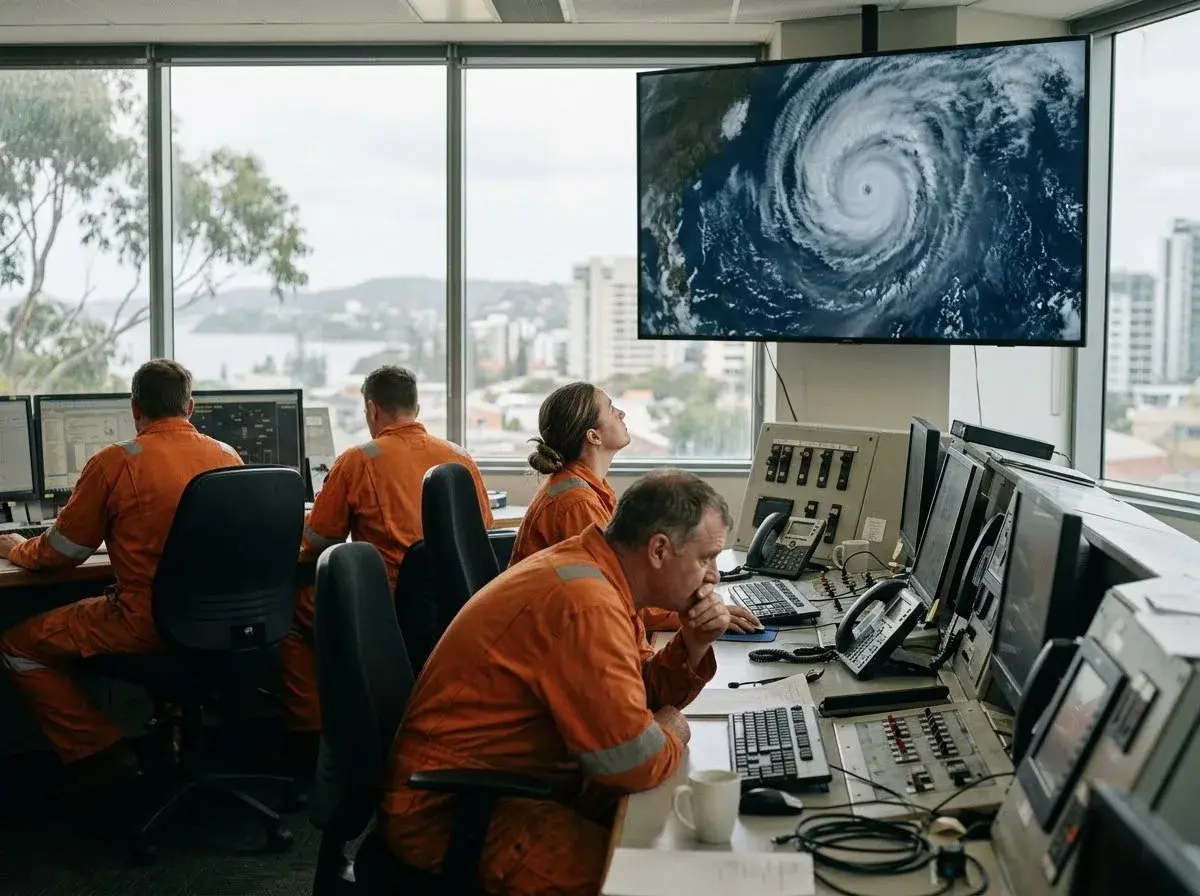
When Cyclone Zelia forced Woodside to take its crews off its North West Shelf gas platforms in February 2025, it directed them to work their normal shifts in its Perth office. The Australian Workers' Union said the enterprise agreement meant demobilised workers should be stood down on full pay instead. The Fair Work Commission found nothing in the agreement stopped the direction, but left open whether the workers' contracts allowed it.
Key points
- An enterprise agreement that is silent on a direction does not, by that silence, take away an employer's right to give lawful and reasonable directions.
- The agreement's cyclone clause kept workers on full pay during the cyclone, as long as they were ready, willing and able to work and went back once the all clear was given.
- Workers sent to Perth kept both their usual pay and the agreement's travel, meal and accommodation entitlements.
- The Commission could only decide what the agreement said; whether the employment contracts allowed the direction was left for another day.
What happened
Woodside's North Rankin and Goodwyn Alpha gas platforms sit about 135 kilometres off the coast from Karratha. Their crews live on board during their swing, fly out by helicopter, and generally work 12-hour shifts on a roster of two weeks on, two weeks off, two weeks on and four weeks off.
In mid-February 2025, Cyclone Zelia, a category three cyclone, hit the Pilbara. Woodside took workers rostered between 12 and 15 February off their platforms. It directed them to work their normal rostered hours at its Perth office. They were paid as usual, and also received the travel, meal and accommodation entitlements the enterprise agreement gives workers who are required to work in Perth.
Woodside's evidence was that this was the first full demobilisation in about five years. Before the last crews leave, control of a platform is handed to a remote operations centre in Perth, which keeps gas flowing while the platform is empty. The platforms cannot be operated from anywhere else. Many tasks, such as planning maintenance and preparing work permits, can be done in Perth, though Woodside's witness accepted they could also be done from home.
The dispute
The Australian Workers' Union (AWU) took a dispute to the Fair Work Commission under the dispute settlement clause of the Woodside Energy Ltd North West Shelf Gas Platforms Enterprise Agreement 2023. An enterprise agreement is a set of employment terms that a majority of the covered employees vote to approve, and this one let the Commission settle disputes about it, if necessary by a binding decision (s 739 of the Fair Work Act 2009 (Cth)).
The union's case turned on clause 11.9, headed ‘Cyclone and Inclement Weather’. It says that when a cyclone prevents safe work on a platform, employees ‘will continue to be paid as usual’ for the hours they would have worked, if they are ready, willing and able to work, mobilise or demobilise, and resume duty immediately after the ‘all clear’. The AWU said this was a stand down clause: workers stop, stay on standby and return after the all clear. On its reading, the agreement allowed workers to be sent to Perth only in two listed cases: when bad weather prevents a crew change, or on a temporary operations transfer.
Woodside did not claim the agreement gave it the power to send workers to Perth. It said the agreement did not take away its ordinary right to direct employees, and that its standard contracts named the Perth office as a secondary work location.
The legal test
An enterprise agreement is read by starting with the ordinary meaning of its words, read as a whole and in context. Because agreements are written by practical people for a particular industry, the Commission prefers a purposive reading, one that gives effect to what the clause is for, over a narrow or pedantic one.
Under s 524 of the Fair Work Act, an employer may stand down an employee who cannot usefully be employed because of a stoppage of work the employer cannot reasonably be held responsible for, and need not pay them for that time. A cyclone that makes a platform unsafe fits that description.
What the Commission decided
Commissioner Matheson found that clause 11.9 is not a stand down clause. It gives Woodside no right to stand anyone down. Its job is to make sure that, where the law would otherwise allow unpaid stand down, platform workers still get their usual pay during a cyclone, so long as they meet its conditions. One condition is being ready, willing and able to work, which means being ready to work when Woodside asks.
The Commissioner also rejected the argument that a worker in Perth could never ‘resume duty immediately’ after the all clear. Read sensibly, workers could not lose the benefit of the clause just because they needed time to get back to the platform from where their employer had sent them.
The cyclone clause and the Perth work clause, the Commissioner found, do different jobs and can both apply at once. There was ‘no express prohibition’ in the agreement on directing workers to Perth during a cyclone, and none could be implied from the agreement's silence. The agreement did not displace the contractual right to give reasonable directions that are lawful and within the scope of the employment.
What was left open
This was not a complete win for Woodside. The Commission's power was limited to what the agreement said, so it could not decide whether the workers' employment contracts allowed the direction. Whether a particular direction is lawful and reasonable, the Commissioner said, may depend on the facts at the time. The Commissioner also noted that the agreement did not clearly cover flights between Perth and the platform for some workers. Expecting workers to pay for that travel, the Commissioner said, could bear on whether a direction is lawful and reasonable, and s 325 of the Act, which stops employers unreasonably requiring employees to spend their own money, may be relevant.
What this means for you
If your workplace is shut by weather or another event outside your employer's control, check your enterprise agreement or contract. It may keep you on full pay where the law would otherwise allow an unpaid stand down, but that protection often depends on you being available to work, including somewhere else. If you are sent elsewhere, check what they say about travel, accommodation and allowances, and consider getting advice early if a direction seems unreasonable in your circumstances.
The takeaway
An enterprise agreement's silence does not stop an employer from giving a lawful and reasonable direction, such as working from another site in an emergency. Whether a specific direction is lawful and reasonable still depends on the contract and the facts.
Note: The Commission decided only what the enterprise agreement allowed. Whether the workers' employment contracts permitted the direction to work in Perth was outside the dispute and was not decided.
Fair Work Commission · 13 November 2025
The Australian Workers' Union v Woodside Energy Ltd [2025] FWC 2341, Commissioner Matheson. Read the full decision
This is a plain-English summary of the published decision, for general information. It is not legal advice, and every case turns on its own facts.
Does this sound like your situation?
More case studies

Fair Work Commission · 12 November 2021
Hotel worker stood down for refusing reduced hours during COVID
Kiah Anastasia Shanks v Schwartz Family Co
A full-time receptionist at a Gold Coast hotel would not agree to a temporary cut in her hours during the 2021 COVID downturn, and was stood down without pay. The Fair Work Commission found the stand down was not authorised by the Fair Work Act, because the hotel was still trading. But weighing fairness to the hotel and its other staff, it refused to order the hotel to pay her for the lost time.
Stand down not authorised, but no pay orderedProblems at work#contracts#for employers
Read the case study
Fair Work Commission · 20 November 2018
Moved to a new office, a new father's commute grew to over five hours
Association of Professional Engineers, Scientists and Managers, Australia v NSW Electricity Networks Operations Pty Limited t/a TransGrid
A Sydney project manager with a new baby was directed to move from the Ultimo office to Wallgrove, and his bike, ferry and train commute grew to more than 5 hours a day. His contract allowed transfers that did not impose unreasonable hardship. The Fair Work Commission found the hardship was real but not unreasonable, and dismissed the dispute.
Relocation upheld; dispute dismissedProblems at work#contracts#redundancy#for employers
Read the case study
Fair Work Commission · 19 January 2026
Hired to work from home, sacked for refusing three office days
Richard Johnson v PaperCut Software Pty Ltd
A Melbourne software worker whose contract said he was 'permitted' to work from home refused his employer's direction to come into the office three days a week, believing his contract protected him. After months of meetings and two final warnings he was dismissed. The Fair Work Commission found the direction was lawful and reasonable, and the dismissal was not unfair.
Unfair dismissal claim dismissedProblems at work#unfair dismissal#misconduct#contracts
Read the case study