Stevedore dismissed as unfit loses disability discrimination case
Mullaney v Qube Ports Pty Ltd [2025] FedCFamC2G 1784
- Decided by
- Federal Circuit and Family Court of Australia (Division 2)
- Date
- 30 October 2025
- Outcome
- Claim dismissed, with costs; appeal dismissed
- Result
- Employer succeeded

After two workplace injuries and years of modified duties, a Port Kembla stevedore was dismissed when a doctor chosen by his employer said he could not return to his full role without risk to his health. He sued for disability discrimination. The court was critical of the medical evidence, but dismissed his claim because of how the case had been framed and because he never put forward an adjustment, and the Federal Court dismissed his appeal.
Key points
- The Disability Discrimination Act 1992 (Cth) protects workers from being dismissed because of a disability, including one the employer believes they have, whether or not they do.
- Direct discrimination needs less favourable treatment than a person without the disability would get in the same circumstances, and how the worker describes the disability shapes that comparison.
- A claim that the employer failed to make reasonable adjustments is much harder to win if the worker never told the employer what adjustment was needed.
- The judge doubted the medical evidence that the worker could not do his job, but the case never reached that question, and as the worker framed it the employer's defence would have succeeded anyway.
What happened
Brenden Mullaney worked for Qube Ports at Port Kembla in New South Wales from around 2007. As a grade 2 stevedore he could be rostered to many tasks, from driving forklifts to lashing: the heavy work of fixing and releasing the chains and bars that secure cargo to a ship.
In June 2017 he slipped on a lashing strap on a ship's deck and hurt his ankle, knee and lower back. In February 2018 his doctor certified him fit for his usual duties, but with "no manual handling of plate dog and lashing equipment". In December 2019 he tripped on a rubber mat and hurt his left knee and ankle, and in August 2020 he had knee surgery. He kept working on light duties.
On 10 September 2021 his doctor cleared him to resume his full ordinary duties. Three days later he was rostered to lash. He told his manager he no longer held the skill qualification, or "ticket", for lashing. Qube then began a fitness-for-work process.
The medical review and the dismissal
Qube sent him to an occupational physician, who examined him by video link. The doctor reported that Mr Mullaney did not have "current capacity to return to his pre-injury stevedoring duties without risk to his health in the foreseeable future". He recommended that Mr Mullaney avoid squatting, kneeling and heavy loads. Yet the same report said he "did not have any objective limited capacity": the doctor's concern was the risk of aggravating degenerative changes in his knees over time.
In October 2021 Qube told Mr Mullaney it had formed the preliminary view that he could not perform the inherent requirements of his role, and stood him down. He replied with another doctor's certificate saying he was "fit for pre-injury duties" and, months later, a physiotherapist's functional capacity report. His union told Qube he was "physically capable of performing most, if not all, of his role". Qube preferred its own doctor's opinion, and on 1 June 2022 it ended his employment.
The claim and the legal test
Mr Mullaney sued under s 15(2)(c) of the Disability Discrimination Act 1992 (Cth), which makes it unlawful for an employer to dismiss an employee on the ground of the employee's disability. A disability includes an "imputed" one: a disability the employer believes the person has, whether or not they do.
He argued two kinds of discrimination. The first was direct discrimination under s 5(1): treating a person less favourably, because of a disability, than the employer would treat someone without it in circumstances that are not materially different. The imaginary person without the disability is called the comparator. The second was a failure to make reasonable adjustments under s 5(2): changes for the worker that would let them do the job, unless those changes would cause the employer unjustifiable hardship.
What the court decided
Judge Manousaridis accepted that Qube had imputed a disability. His written submissions had described it as "degenerative changes to his back, shoulders and knees which prevented him from performing the occupational requirements of his role", and the judge found that Qube's letters attributed exactly that to him.
That wording decided the comparison. Following the High Court's approach in Purvis v New South Wales, the judge first identified all the circumstances of the dismissal. Because Mr Mullaney's own description of the disability included an inability to do the job, that inability was one of those circumstances. The question became how Qube would have treated a worker without the disability who was also believed unable to do the job. Qube's evidence that it would have dismissed that worker too was not challenged, so the judge found Mr Mullaney had not been treated less favourably.
The adjustments claim failed for a simpler reason. Before he was dismissed, Mr Mullaney never put forward any specific adjustment Qube could make; his union's position was that he could do most or all of the job. The claim was dismissed and Mr Mullaney was ordered to pay Qube's legal costs.
Weak medical evidence, and the appeal
The judge criticised the occupational physician's report. The doctor was not an orthopaedic surgeon, lacked the scan results when he wrote it, and did not say how large the risk was. Qube's roster log showed he had worked 2,195 shifts between February 2018 and October 2021. On the medical evidence, the judge would not have been satisfied that Mr Mullaney was unable to perform the inherent requirements of his job. But that defence, in s 21A, only arises once discrimination is proved, and on the case as framed, the judge thought Qube's defence would have succeeded anyway.
Mr Mullaney appealed, arguing the comparison was circular. On 22 July 2026 Justice Lee of the Federal Court dismissed the appeal: it turned on how the case had been run at trial, not on legal principle. He added that not every imputed-disability case will fail at the comparator stage.
What this means for you
If your employer says you are medically unfit for your role, it is worth getting advice early. How the disability is described can decide the case.
It is worth putting any adjustment you need in writing before a decision is made: which tasks you cannot do, what could change, and the medical evidence that supports it.
Employers should note the court's scrutiny of a medical report that spoke of a "possible risk" without measuring it. An unfair dismissal or general protections claim may also be open after a dismissal like this, and must be lodged with the Fair Work Commission within 21 days.
The takeaway
A disability discrimination claim can be lost on how the disability is described and on whether adjustments were ever asked for, even where the employer's medical evidence is weak. It is worth asking for specific adjustments in writing before the employer decides.
Note: Mr Mullaney's appeal was dismissed by Justice Lee in Mullaney v Qube Ports Pty Ltd [2026] FCA 955 (22 July 2026). The disability discrimination provisions applied in the case have not changed since.
Federal Circuit and Family Court of Australia (Division 2) · 30 October 2025
Mullaney v Qube Ports Pty Ltd [2025] FedCFamC2G 1784, Judge Manousaridis. Read the full decision
This is a plain-English summary of the published decision, for general information. It is not legal advice, and every case turns on its own facts.
Does this sound like your situation?
More case studies
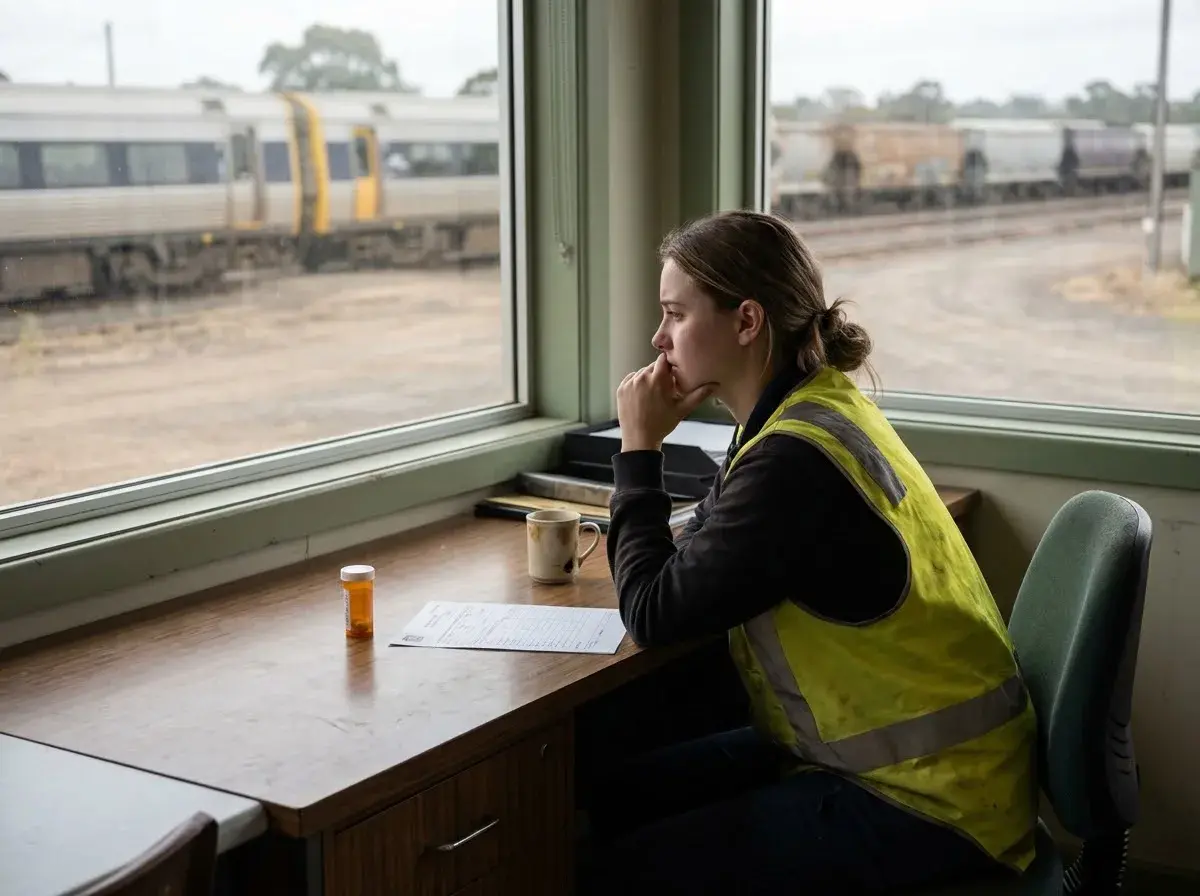
Full Court of the Federal Court of Australia · 12 September 2024
Trainee train driver with ADHD wins discrimination case, then loses it
State of New South Wales - Sydney Trains v Annovazzi
A trainee train driver with ADHD and Asperger’s Syndrome was dismissed on probation after her employer concluded she had not disclosed her conditions before she was hired. A judge found the dismissal was disability discrimination, but the Full Federal Court set that aside, and on the rehearing her claim was dismissed.
Trial win overturned; claim dismissed on rehearingDiscrimination & bullying#disability#discrimination#investigations
Read the case study
Federal Circuit Court of Australia · 24 November 2017
Security officer loses obesity discrimination claim after site removal
Findley v MSS Security Pty Ltd
A security officer who opposed his employer's new enterprise agreement was accused of hiding past work from his resume, then removed from his university post at the client's request and dismissed after refusing roles that involved walking. The Federal Circuit Court found the accusation was wrong, but that it was not made because of his bargaining activity, and that he was not discriminated against because of his obesity.
Claim dismissedDiscrimination & bullying#disability#discrimination#general protections
Read the case study
Guide · first published March 2017
Dismissed because of a disability? Four cases on how the law works
The Fair Work Act protects employees from being dismissed or otherwise treated badly because of a physical or mental disability. This guide explains how a general protections claim on that ground works, and why the employer has to prove its reason, through four court decisions: two workers who won and two who did not.
GuideDiscrimination & bullying#general protections#disability#discrimination
Read the guide